Physics-Informed Neural Network Modeling of Compressible Gas Flows
High-fidelity simulations of compressible gas flows require resolution over a wide range of spatial and temporal scales.
- Conventional CFD methods can become computationally expensive for large-scale parametric studies, inverse problems, and repeated evaluations.
- Purely data-driven neural networks may require large amounts of high-fidelity training data and do not inherently satisfy the governing conservation laws.
Toward Fast and Physics-Consistent Flow Prediction
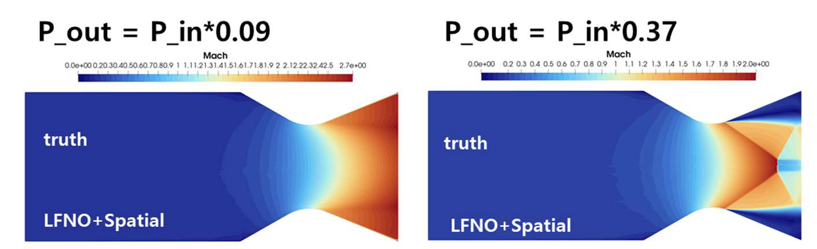
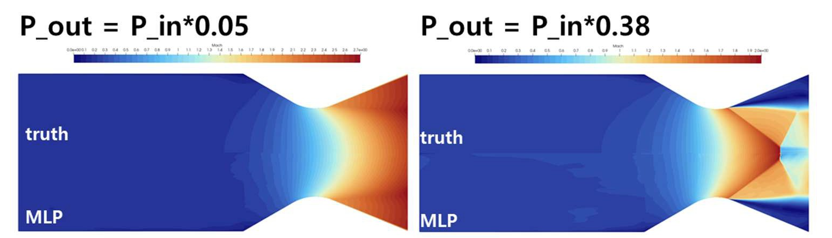
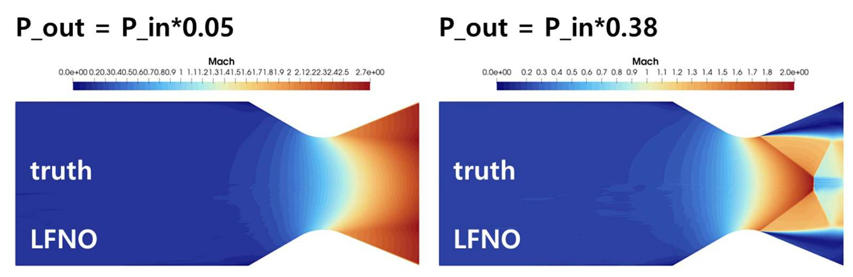
Compressible gas flows involve strong nonlinearities and sharp flow structures, including shock waves and expansion waves, making accurate and efficient flow prediction challenging. Conventional CFD provides high-fidelity solutions but can become computationally expensive for repeated evaluations, inverse problems, and large parametric studies. Physics-informed neural networks (PINNs) incorporate the governing Euler and Navier–Stokes equations directly into neural-network training, providing a physics-constrained approach to flow prediction. By improving shock treatment, adaptive sampling, and domain-decomposition strategies, PINN-based modeling can enable efficient forward and inverse simulations for high-speed aerodynamic and aerothermodynamic flows.